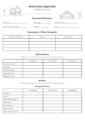
Whether you’re a brand-new landlord or a seasoned pro, a Maine rental application is a lawful (and smart) way to evaluate prospective tenants based on their reliability and readiness. In the Pine Tree State, where there is a diverse mix of seasonal and year-round rentals, a well-written rental application template can help streamline your application processes.
Use this guide (and trusted landlord software) to simplify tenant screening, speed up decision-making, and stay aligned with state and federal regulations.
Information to Collect
Common information in a Maine rental application includes:
- Applicant names, co-applicants, co-signers, date of birth, Social Security number, email, phone number, and emergency contact
- Employment, income, and rental history
- Personal and professional references
- Current and previous addresses
- Pet or animal information
- Smoking status
- Vehicle information (e.g., make, model, color, etc.)
State and federal laws limit the questions landlords may ask and how they use that information during the screening process.
Quick Guide to Screening a Tenant
Here is a practical approach to tenant screening that reflects the key elements of responsible applicant evaluation in Maine’s mix of rural and coastal rental markets.
1. Pre-Screen
Use a short pre-screening form to determine whether a prospective tenant meets your basic criteria.
They often include questions about:
- Basic contact information
- Current job or source of income
- Monthly earnings or salary range
- Estimated credit score
- Preferred move-in date
- Total number of occupants
- Whether the tenant has pets or service animals
- Smoking habits
While these questions are helpful, they don’t replace a complete Maine rental application.
2. Conduct Showings
Once you’ve identified qualified applicants, schedule individual appointments or small-group viewings to show the rental.
Meeting prospective tenants in person helps Maine landlords build rapport and gain insight.
3. Distribute and Collect Applications
After a showing, share your Maine rental application with interested tenants and explain any non-refundable fees upfront (Me. Rev. Stat. tit. 14, § 6030-H).
Maine Application Laws
Maine has several state-specific landlord-tenant laws that guide how you can collect and use application information.
Source of income: As of 2024, Maine law prohibits discrimination based on lawful sources of income, including housing vouchers or public assistance (Me. Rev. Stat. tit. 5, § 4581-A(4)).
Criminal history: Maine does not limit a landlord’s ability to conduct a criminal background check when reviewing applicants.
Eviction history: Landlords in Maine may also review an applicant’s prior eviction records as part of the screening process.
Sexual orientation & gender identity: Maine’s Human Rights Act offers broad housing protections that include sexual orientation, gender identity, and gender expression (Me. Rev. Stat. tit. 5, § 4581 et seq.).
Portable tenant screening reports: There is no requirement under Maine law for landlords to accept portable tenant screening reports.
Pets, ESAs, and Service Animals
Maine landlords are free to establish their own pet policies. However, they cannot refuse housing or apply different terms to applicants who rely on a service animal or an Emotional Support Animal (ESA).
Pet information: When collecting applications, ask tenants to disclose whether they have pets, ESAs, or service animals.
Fair Housing Act: Both Maine and federal law protect individuals who need assistance animals. Under these laws, landlords may not charge pet deposits, pet rent, or additional fees for service animals or ESAs, nor can they deny a unit based on the animal’s breed or size (Me. Rev. Stat. tit. 5, § 4553–1–H).
Federal Application Laws
In addition to Maine’s own housing protections, landlords must comply with several key federal regulations that govern how they collect, review, and use rental application information.
Fair Housing Act (FHA): Under this federal law, landlords must treat all applicants equally, regardless of race, color, national origin, religion, sex, familial status, or disability (42 U.S.C. § 3601).
Fair Credit Reporting Act (FCRA): When a landlord denies housing based on credit data, they must send an adverse action notice that identifies the reporting agency and explains the applicant’s right to dispute the information (15 U.S.C. §§ 1681-1681x).
Equal Credit Opportunity Act (ECOA): The law prohibits landlords from discriminating against applicants who receive public assistance and defines how credit information may be used when assessing financial eligibility (15 U.S.C. § 1691).
Americans with Disabilities Act (ADA): States that landlords have a legal duty to make reasonable accommodations for applicants and tenants with disabilities (42 U.S.C. § 1210).
4. Use a Third-Party Screening Service
Partnering with a reputable tenant screening service allows Maine landlords to simplify the application process while staying compliant with state and federal regulations. Third-party platforms can securely handle background, credit, and eviction checks.
5. Check Application References
In Maine, landlords gain valuable insight by checking each applicant’s references directly. Contacting previous landlords confirms whether tenants paid rent on time, maintained the property, and followed lease terms. These reference checks help landlords make informed, confident decisions before approving a new tenant.
6. Approve or Deny Applications
When reviewing and accepting multiple applications, Maine landlords should use consistent, objective criteria to make fair and well-documented decisions.
- Rental history: If an applicant has limited or no rental experience, request additional references or consider requiring a co-signer.
- Rent-to-income ratio: A practical benchmark for financial stability.
- Credit score: Aim for applicants with a credit score in the 600–670 range or higher.
- Fact-check the rental application: Verify the accuracy of all information provided.
Denial Process
Landlords in Maine should follow an established process to comply with fair housing laws.
Denial notice: Maine law does not require landlords to issue a tenant rejection letter.
Credit/Background denials: The FCRA requires an adverse action notice if you deny an application based on credit or background information.
Document storage: Keep copies of denied applications and any related screening documentation for at least 3 years.
Avoiding Fraud
Unfortunately, Maine landlords aren’t immune to rental application fraud. Taking a few extra verification steps early helps prevent costly mistakes.
Confirm each applicant’s identity, verify income and employment, and contact previous landlords to cross-check references. Stay alert for red flags such as rushed submissions, incomplete details, or documents that don’t add up.
Maine Rental Application FAQs
What is required to rent an apartment in Maine?
Applicants must complete a Maine rental application, provide valid identification, and submit any required application fees. Landlords may also request consent for credit reports, tenant background checks, and reference verification to confirm an applicant’s reliability and eligibility.
Do you have to pay to submit a rental application?
Yes. Maine landlords may charge a reasonable, non-refundable application fee to cover the cost of screening, such as credit and background checks (Me. Rev. Stat. tit. 14, § 6030-H).
What are the reasons a rental application can be denied?
Landlords may deny applications for legitimate reasons, such as insufficient income, poor credit history, prior evictions, false information, or unsatisfactory background checks.
How long does a landlord have to make a decision about a rental application?
Maine law does not set a specific timeframe for reviewing applications, but most landlords make a decision within a few days of receiving all required information and screening results.