When a tenant who’s renting out your extra bedroom refuses to leave or fails to pay rent on time, a room rental agreement in Utah is your best line of defense. Just like a Utah lease agreement for an entire property, a room rental agreement lays the groundwork for your tenancy. It clarifies the responsibilities of both parties, helping landlords and tenants avoid disputes and defend themselves if problems arise.
In this guide, we’ll cover mandatory disclosures, contract types, and federal and state rental laws. We’ll also discuss how property management software streamlines the landlord workflow, whether you’re renting out a whole home or a single room.
Room Rental Laws
While federal guidelines apply to all rental arrangements, each state also sets its own rules. Here’s a quick overview of landlord-tenant laws in Utah:
- Landlords must notify tenants before entering their room.
- You must respect the tenant’s quiet enjoyment of their unit.
- Provide and maintain a safe, habitable living environment.
- Make all mandatory disclosures.
We’ll discuss all the laws governing your Utah room rental agreement after a few words on contract types.
Different Types of Room Rental Agreements in Utah
To create a room rental agreement in Utah, start by choosing one of the following formats:
- Verbal agreement: Although many landlords prefer word of mouth, we recommend a written lease for greater enforceability.
- Fixed-term lease: Because these written contracts set a specific start and end date, they provide both parties with stability and clarity.
- Month-to-month lease: “Tenancy at will” leases work best when landlords and tenants need flexibility. They renew each month, but you can terminate them with proper notice.
Think about your relationship to the tenant, the lease agreement’s length, and whether you need flexibility or stability. For example, if you can’t commit to renting out the room for 6 months to 1 year, a month-to-month lease may be your best bet.
Required Landlord Disclosures
Every room rental agreement in Utah must include the following disclosures:
- Lead-based paint: Tell tenants about all lead-based paint hazards if the rental property was built before 1978 (42 U.S.C. § 4852d).
- Move-in checklist: Provide a written overview of the room’s condition before move-in, and allow tenants to inspect the unit during the walkthrough (Utah Code § 57-22-4).
- Landlord’s information: Give tenants the landlord’s or property manager’s name, address, and contact details (Utah Code § 57-22-4).
- Methamphetamine hazards: If anyone has used, produced, or stored methamphetamines in your rental property and you’re aware, you must tell tenants and report it to local authorities (Utah Code § 57-27-201).
Additionally, here’s a quick summary of the laws governing your Utah room rental agreement:
Security Deposit Rules
Maximum security deposit: State law doesn’t cap the amount landlords charge for security deposits.
Security deposit receipt: Utah law doesn’t require them.
Deduction tracking: Landlords must provide tenants with an itemized list of deductions in writing (Utah Code § 57-17-3).
Security deposit return: Landlords must return the security deposit (including a list of deductions) within 30 days of move-out or 15 days after receiving the tenant’s forwarding address, whichever is later (Utah Code § 57-17-5).
Pet deposits: If you make your pet deposit non-refundable, you must notify tenants in writing (Utah Code § 57-17-2).
Rent Payment Rules
Late rent fees: State law caps late fees at the greater of 10% of 1 month’s rent or $75 (Utah Code § 57-22-4).
Right to withhold rent: In Utah, tenants generally can’t stop paying rent, even if there are property issues. No state laws specifically allow tenants to withhold rent.
Grace period: Utah law doesn’t require a grace period, but landlords can choose to add one to their lease agreement.
Pet rent: If you collect pet rent, you must include related terms in your lease. However, federal law prohibits you from charging any kind of fee for service/support animals (42 U.S.C. § 3601 et seq.).
Rent Payment Increase Rules
Rent payment increase frequency: State law doesn’t govern rent increase frequency, but you typically can’t increase rent mid-tenancy.
Rent payment increase maximum: Utah doesn’t cap rent increase amounts.
Rent control/stabilization: Local governments can’t set their own rent control policies unless the state approves them first (Utah Code § 57-20-1).
Room Rental Agreement Breaches
Failure to pay: Landlords can initiate the eviction process when tenants don’t pay rent by sending a 3-Day Notice to Pay or Quit (Utah Code § 78B-6-802).
Lease violations: Utah law requires landlords to send a 3-Day Notice to Cure or Quit for fixed-term leases, and a 15-Day Notice to Cure or Quit for month-to-month tenancies (Utah Code § 78B-6-802).
Self-help evictions: State law prohibits landlords from forcing tenants out of their rooms using any methods outside the legal, court-ordered process (Utah Code § 78B-6-814).
Terminating a Room Rental Agreement
Month-to-month: You must give 15 days’ notice in writing to terminate tenancy-at-will agreements (Utah Code § 78B-6-802).
Fixed-term: Attempting to terminate a fixed-term lease before its end date usually results in penalties.
Room abandonment: Landlords must send the tenant an official notice of abandonment and give the tenant 24 hours to dispute it before repossessing the room (Utah Code § 78B-6-815).
Tenant’s right to terminate: Victims of domestic violence, burglary/aggravated burglary, sexual assault, or stalking can terminate their lease with written notice under the following conditions:
- The tenant hasn’t breached their lease.
- The tenant submits documentation, such as a police report.
- The tenant pays the owner 45 days’ rent (Utah Code § 57-22-5.1).
Landlord Access Laws
Immediate access: State law doesn’t explicitly allow landlords to enter a tenant’s room without notice. However, landlords can usually enter immediately in serious emergencies, such as fires or floods.
Landlord harassment: You can’t disturb a tenant’s peaceful enjoyment of their room by abusing your right of entry.
Advance notice: Landlords must give tenants 24 hours’ notice before entering their room (Utah Code § 57-22-4).
Lease Agreement Renewal and Termination
Required renewals: If both parties want to renew a fixed-term lease, they must sign a new room rental agreement in Utah.
Required notice: Landlords and tenants must give 15 days’ written notice to terminate the agreement (Utah Code § 78B-6-802).
Month-to-month considerations: State law treats a fixed-term lease as month-to-month if the original agreement ends and the tenants continue renting the room.
Keep these laws in mind when you rent out your extra bedroom. To make the entire leasing process easier and more efficient, try using tech-enabled property management software.
Room Rental Agreement Utah FAQs
What should be included in a Utah room rental agreement?
Every room rental agreement in Utah should include the following elements:
- Disclosures
- Rent and security deposit details
- Tenant responsibilities
- House rules
How do I legally rent out a room?
Create a Utah room rental agreement form, make all mandatory disclosures, and provide a safe, habitable living space.
How to make a Utah room rental agreement?
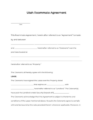
Try using the printable PDF template linked at the top of this article. It’s simple, quick, and legally compliant.